Haptic interaction for yoga
Exploring haptic feedback for yoga
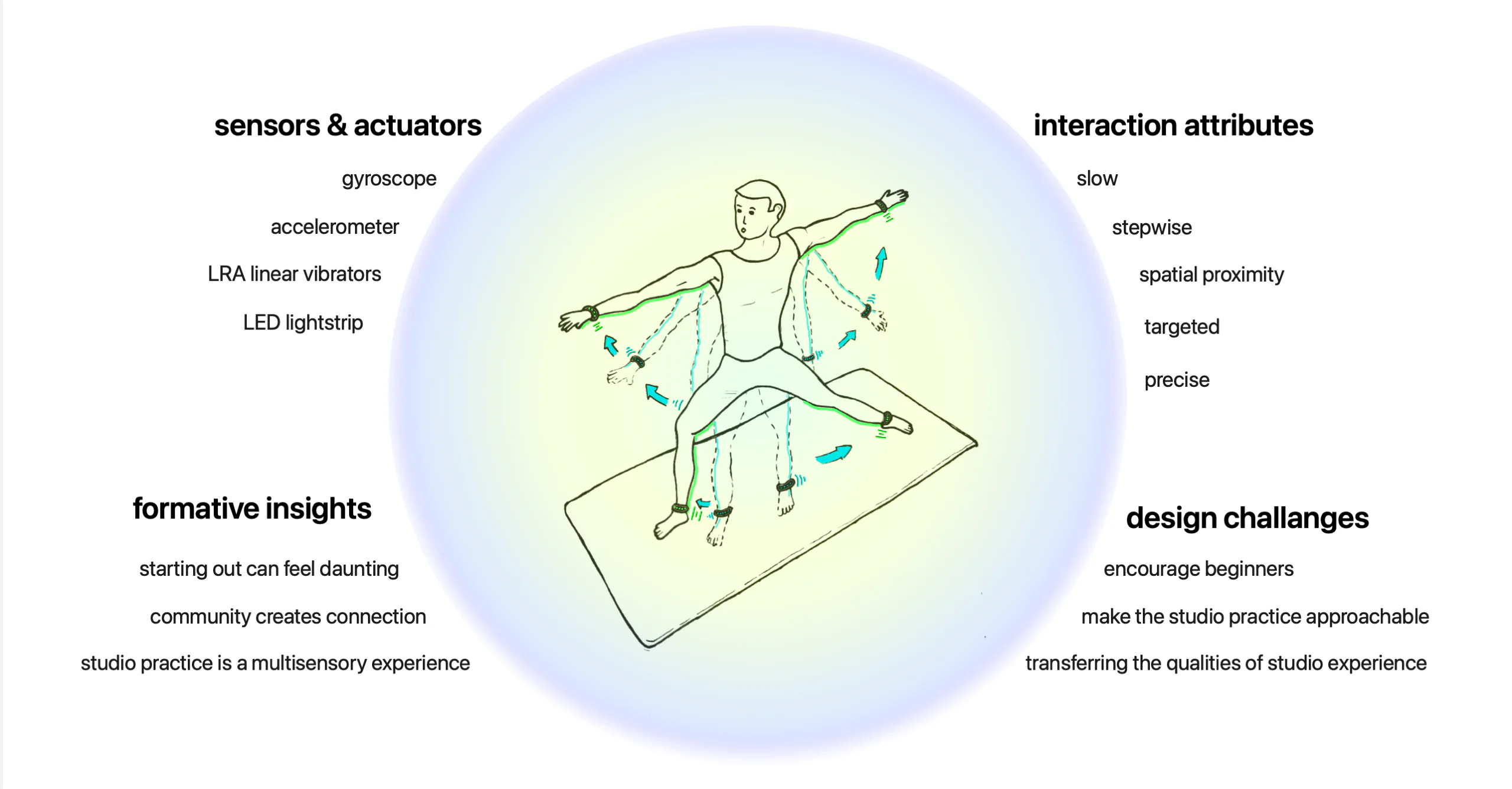
Role
Interaction Designer & Prototyper
Team
4
Introduction
This project was developed as part of an interaction design course during my Master´s program at Malmö University, where we explored the intersection of aesthetics and somatics.
Litterature Review
Camille Moussette and Kristina Höök’s work on Soma Design emphasizes designing through bodily experience rather than abstract representation. By treating sensation, movement, and reflection as design materials, soma design provides a strong foundation for exploring haptic feedback and embodied guidance in movement-based practices like yoga.
How Might We
How might we encourage beginners to join yoga classes by bringing the qualities of the group experience into individual practice to make the studio practice approachable?
Ideation
Our sketching process began with a focus on haptic design, guided by the principle that 'to design haptics is to feel haptics.' As expressed by Camille Moussete, effective haptic design requires directly experiencing the tactile feedback we create, much like trying to draw without sight—without feedback, the experience remains incomplete and assumptions can arise.
Framework
Reflecting on our ideation, we embraced the idea that 'to design haptics is to feel haptics.' We realized that relying solely on drawings was inadequate in capturing the full sensory experience of haptics. Therefore, we chose to focus on the artifact’s behavior, using sketching methods that enabled us to feel touch directly. This approach prioritized actuation over computation, allowing us to define what the system should do before determining how it should function.
Bodystorming
To deepen our exploration, we incorporated bodystorming to simulate interactions between the user and the system. One person moved through a yoga flow while another took on the role of the 'system,' providing touch-based cues that simulated vibrations. This hands-on role-playing enabled us to experience how subtle tactile feedback could influence the user's flow and help us better understand embodied interactions. Through this process, we identified three ways to bodystorm haptics: tapping, holding, and grabbing, prompting us to explore how touch type and force could affect movement.
TinyML
As our bodystorming progressed, we aimed to add a layer of immersion by integrating electronics into our prototyping. We initially used the Arduino BLE 33 with a camera module to activate a vibrator and LED strip upon detecting a person. This setup provided valuable insights, as the code would later be incorporated into our prototype. However, the machine learning model’s size exceeded the Arduino's 1 MB capacity, complicating quantization. To streamline testing, we switched to a micro:bit, which, although simpler, served as a practical tool for early-stage exploration.
Micro:bit
The micro:bit allowed us to sketch haptic interactions within practical constraints, enabling us to create nuanced vibrations by adjusting code. This setup facilitated initial experimentation with actuation timing, helping us test how subtle variations in vibration could enhance feedback. Although we included an LED strip for visual feedback, our main focus was on haptic sensations, which we aimed to refine as the primary modality in our design.
Prototype
We developed a bracelet prototype using two micro:bits, foam, bands, and a glue gun. Each bracelet included four vibrators positioned to indicate directional cues—up, down, left, and right. The prototype’s assembly allowed for directional vibrations that guided user movements, providing an initial tactile framework for real-time interaction.
Testing
Our primary goal was to test how haptic feedback could guide and encourage mindful body movements in yoga. We explored two interaction approaches: one using resistive feedback as a gentle boundary, and the other providing a confirming tap for correct positioning. In the resistive approach, a longer vibration indicated when the user exceeded a boundary, stopping once they returned within range. The second approach gave a light tap when the user achieved the correct pose, reinforcing positive positioning. This setup used four vibrators positioned to indicate directional cues—up, down, left, and right.
Reflection
Our sketching approach confirmed that 'to design haptics is to feel haptics,' reinforcing the importance of directly experiencing tactile feedback. Participants followed the feedforward vibrations effectively but began combining sequential directions into single movements. In a second experiment, participants responded to voice instructions with pulse vibrations confirming spatial targets. However, testing revealed that resistance vibration was less intuitive, leading us to exclude it from the design.
Written in collaboration with ChatGPT-4o