Cognizant: LLM memory system
An LLM-based reading companion that prioritizes long-term understanding by compressing, reflecting, and selectively forgetting—designing memory as a cognitive system.
Role
UX Designer & Developer
Timeline
Feb 2025 – Ongoing
Team
1
Introduction
Cognizant explores how LLM-based systems can support long-term understanding through reflection rather than accumulation. Instead of storing everything a user reads or writes, each reading session is compressed into higher-order insights. These insights are evaluated, revised, or forgotten over time, allowing the system to evolve alongside the reader. The project treats memory as a designed behavior—shaped by constraints, decay, and reinterpretation—rather than passive storage.
Challenges
Most LLM reading tools optimize for recall and retrieval. Over time, notes, summaries, and highlights accumulate endlessly—overwhelming users and exceeding practical context limits. The challenge was to design an AI system that supports long-term sense-making by behaving more like human cognition: selective, interpretive, and adaptive—while remaining technically feasible within real LLM constraints.
The Problem: Accumulation ≠ Understanding
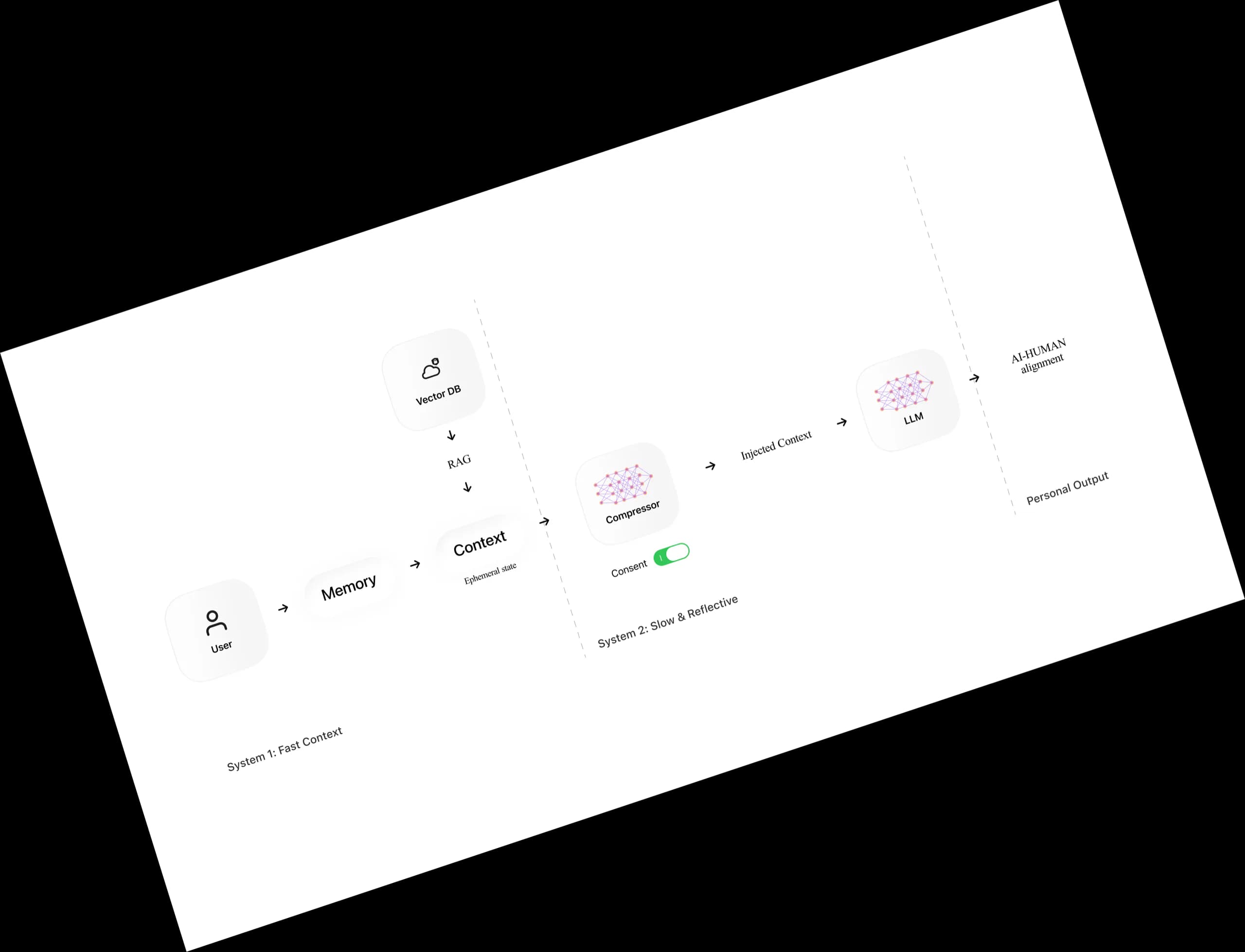
Most agentic tools treat memory as storage. Over time, this leads to bloated note systems that remember everything but help users understand less. Cognizant reframes memory as an interpretive process—where meaning emerges through compression, reflection, and selective focus. This perspective shaped both the interaction design and the underlying system behavior.
Ethical Positioning
Cognizant treats memory as something you would willingly share with another person—not something silently extracted or surveilled. Reflection is triggered intentionally at session boundaries, not continuously. Users retain control over what persists, what fades, and what is removed entirely. Ethical constraints were treated as design inputs, not afterthoughts.
Interaction Design
I originally combined two decisions into one button (“Yes, analyze & leave”), which increased cognitive load and made it easier for users to accidentally grant AI consent while simply trying to exit. I revised the dialog to separate navigation (“Leave” vs “Keep reading”) from permission by moving consent into its own toggle. This ensured consent was explicit, reduced friction, and clarified intent at a cognitively sensitive moment.
Memory Architecture
The system is structured into three cognitive layers: Session Memory (ephemeral reading context), Reflective Memory (derived insights, themes, and gaps), and Core Memory (a constrained set of 7±2 stable traits or preferences). Each layer answers a different question: What am I reading now? What did it mean? What actually changed me?
Insight Generation as Judgment
Reflection is not summarization—it is a judgment about what deserves to persist. At the end of each session, the system produces concise summaries, key insights, and emerging themes or gaps. These outputs are intentionally revisable, allowing understanding to evolve rather than solidify prematurely.
Evaluation as a Design Material
Because Cognizant interprets a person’s reading and thinking over time, mistakes are not just errors—they shape understanding, confidence, and identity. This made evaluation a first-class design concern rather than a technical afterthought. Insight generation and evaluation are deliberately separated: a lightweight model proposes candidate reflections, while a more deliberative reasoning model evaluates whether those reflections are appropriate. Insights are assessed against qualitative design criteria—grounded confidence, interpretive stability, epistemic humility, conceptual specificity, and thematic drift. Evaluation is used to surface failure modes such as overconfidence, vagueness, or premature stabilization. Over time, it became clear that poor evaluation results often pointed to poorly framed criteria rather than weak model performance, reframing evals as an interpretive design tool closer to usability testing than benchmarking.
Metadata as a Design Material
Metadata functions as scaffolding for sense-making rather than technical overhead. Insights are tagged with stability, confidence, temporal relevance, and origin. This enables intentional forgetting, prevents long-term clutter, and allows the system to reason about which memories should persist, decay, or be replaced.
Reflection
Designing Cognizant shifted my focus from interface-level AI interactions to system-level cognitive behavior. By treating forgetting, compression, reinterpretation, and evaluation as first-class design elements, I explored how AI systems can better align with human expectations of intelligence. Cognizant continues to evolve as a live testbed for reflective, long-term human–AI interaction.
Written in collaboration with GPT-5.2