Modular
Design process
Introduction
"Our Common Future," also known as the Brundtland Report, defines sustainable development as "development sustainable to ensure that it meets the needs of the present without compromising the ability of future generations to meet their own needs". In this definition of sustainable development, the Brundtland Report implies global well-being for future generations. Sustainable development consists of three pillars: economic prosperity, respect for the environment, and social equity.
Circularity and design
Modularity and standardization play crucial roles in prolonging product lifetimes. Designing products with interchangeable components and standardized interfaces enables easier repair and upgradeability, reducing the need for replacement. Moreover, involving users in customization, co-design, and repair activities fosters a sense of ownership and attachment, further extending the product’s functional life. The benefits of designing for longevity extend beyond individual products to environmental sustainability. By extending product lifetimes, we can reduce the environmental impact associated with manufacturing, transportation, and disposal. Embracing EDD and re-use strategies can lead to a more circular economy, where resources are utilized more efficiently and waste is minimized. This concept strvies to follow Bakker’s emphasis on circularity through designing a product with modulairty, long lasting and reused materials in mind.
Everest backpack
At the beginning of the course, each group was given a product to analyze with the aim of finding out its environmental impact. The product analysis began with identifying every material, manufacturing technique, and means of transport. A life cycle analysis could then be carried out using the Granta edupack program. Each seam was ripped open to identify all the materials and manufacturing techniques. The first thing we noticed was the number of parts and different materials that the product consisted of. There were also no labels with information about materials and care instructions, which can make it difficult for a user to sort correctly when disposing of waste. The product analysis gave us a greater understanding of what is required and used in manufacturing in a linear economy. This made us rethink and come up with new solutions.
Modular backpack
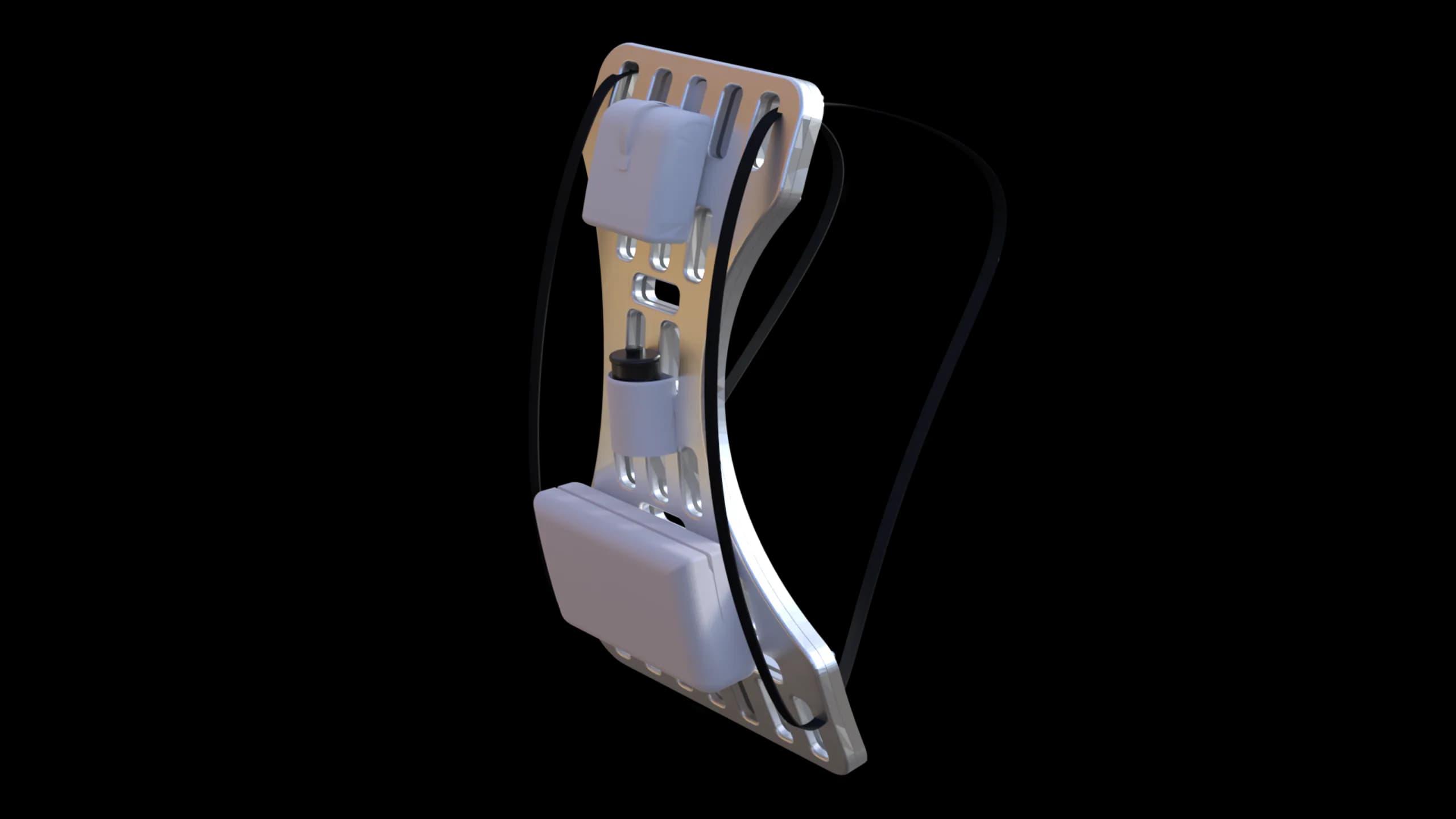
The product had to have the same main function as the Everest backpack but be adapted for a circular economy. My design process began with limiting the number of materials as this increases the efficiency of repair and waste management at the end of the product’s life. In the second module of the course, we were given the task of designing a backpack based on the technical loop. Inspired by Chapman’s ”emotional durable design”, decided that the backpack should be modular as modularity can strengthen the relationship between user and product. This strengthens the emotional value and can increase the psychological lifespan. My individual project is a further development of the concept.
Manufacturing
When a backpack needs to be carried for long periods, using a manufacturing technique that creates a lightweight yet strong structure is crucial. A lighter weight also reduces carbon dioxide emissions during transportation. Aluminum is frequently used in sporting equipment and bicycles because of its excellent balance between weight and strength. The material is flexible and has a low density, making hydroforming a suitable technique for creating complex shapes. Aluminum can be recycled without losing its quality, making it a good choice in a circular econom. This is why aluminum was chosen for the backpack’s frame and modular plug. Hydroforming is an advanced manufacturing technique used to create complex shapes from aluminum sheets. This technique is used for both the frame and the modular plug. PVI Hydroforming AB in Vansbro can produce intricate details from aluminum sheets and offer laser cutting.
Ideation
During my sketching process, I focused on developing the shape of the backpack’s frame. I also explored different solutions for the modular system and the frame’s back support. One possible solution would be to place a softer material between the frame and the body (see sketch above). Since aluminum is not a material that you want against the body for long periods of time, I started exploring where on the body I could place the back support.
Prototype
I re-used material from the everest packback and simply 3D printed plugs to create a modular rack that represents the aluminum frame in the final concept. Although PLA plastic is biodegrable and more environmental friendly than traditional plastics, recycled aluminum is still a more sustaible choice. The material was used as it allows for rapid prototyping.
LCA
A life cycle assessment (LCA) is a method for evaluating the environmental impacts of a product or service throughout its entire life cycle, from raw material extraction to waste disposal. This study aimed to compare the environmental impacts of two backpacks by conducting an LCA of each backpack, from material extraction to waste management. The first step was to analyze the Everest backpack to identify potential improvements in terms of materials, manufacturing techniques, and transportation. One reason for the high environmental impact of the Everest backpack was that many of its components (polymers) were made from crude oil and transported from the USA to China. All parts were then shipped to Bangladesh for assembly and finally to Jönköping, Sweden. To reduce the environmental impact of the new backpack, the number of materials was reduced and only recycled materials were used. Additionally, manufacturing facilities in Sweden were chosen. This resulted in a lower carbon footprint and energy consumption for the final product. The weight of the frame was calculated by multiplying the density of aluminum (2.7 g/cm3) by the volume. One bag module was included in the analysis, and the weight of the remaining components was estimated to be 0.3 kg. Thus by minimizing the number of materials and choosing local manufacturing, it was possible to reduce the product’s energy consumption and carbon footprint. The results of this study demonstrate that it is possible to significantly reduce the environmental impact of a backpack by making thoughtful choices about materials, local manufacturing, techniques, and transportation.