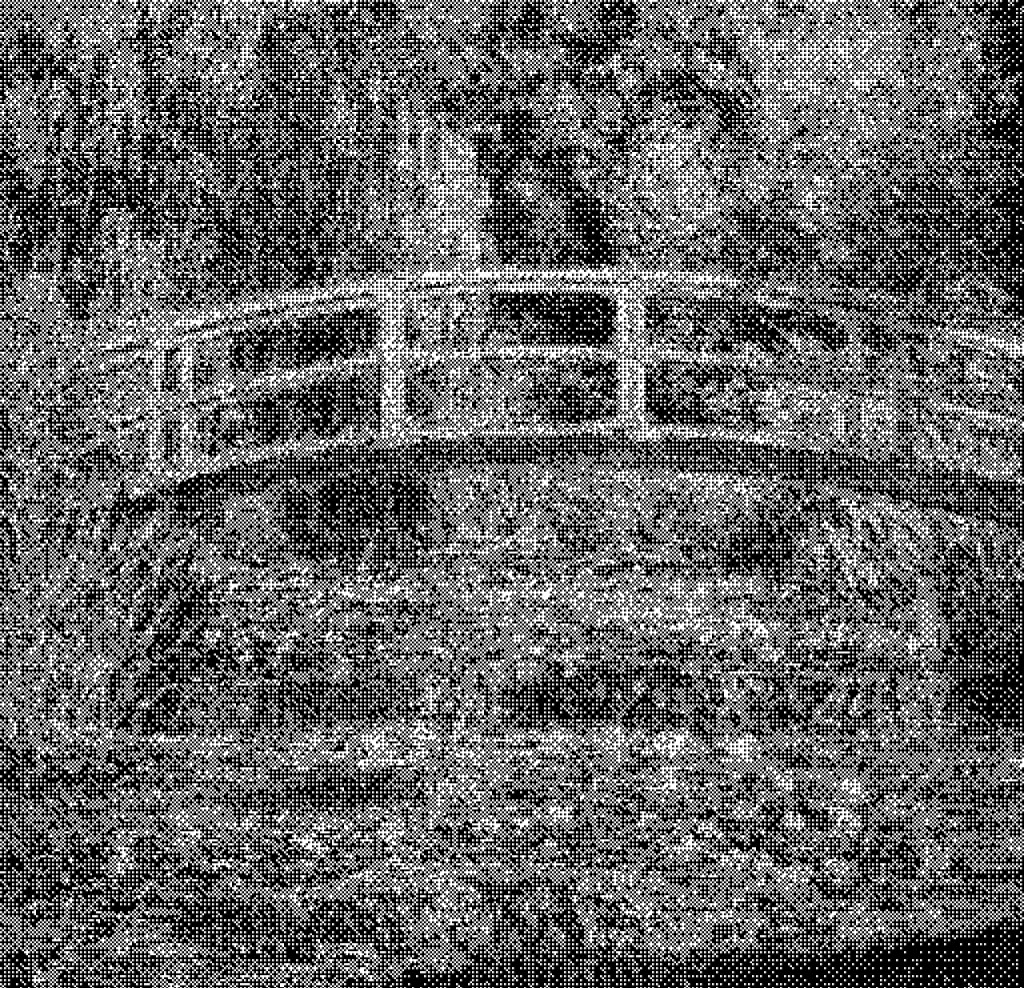
There is a question that sits quietly at the heart of two very different art movements, separated by more than a century: how do you depict a texture, a tone, a feeling using only materials that fall short of it? The impressionist painter and the dithering algorithm arrived at the same answer, independently, across time. You don't render the thing completely. You render enough of it, and trust the human to close the gap.
Stand close to a Monet and you see thick, restless daubs of paint that seem to argue with each other. Step back twenty feet and the chaos resolves into water. Into light. Into a feeling of an afternoon no photograph has ever quite captured. The painting was never finished in the close-up view — it was always only finished in the eye of the person standing in front of it. The canvas is one half of a collaboration; the viewer is the other.
Now consider a computer screen in 1984, tasked with rendering a photograph using only black and white pixels. No gray exists in its palette. And yet: scatter black pixels sparsely across a white field, and gray appears — not on the screen, but in the mind of whoever is looking. This is dithering. It places marks that are individually wrong, in a pattern that is collectively right, and relies on human perception to do the synthesis.
The technical details differ. Impressionism diffuses colour across brushstrokes through intuition; Floyd–Steinberg dithering diffuses quantisation error mathematically across neighbouring pixels. But the logic is identical: neither system tries to achieve a perfect local truth. Both accept that local imperfection, distributed across enough of the canvas, produces something globally more true — and more alive — than precision would.
What makes this more than a clever analogy is what both traditions were reacting against. Academic painting in the 1860s prized smooth, invisible brushwork — surfaces that erased all evidence of the artist's hand. The impressionists left the marks in. Critics called it sloppy. History called it a revolution. Digital aesthetics has always chased the same smooth surface: more pixels, finer gradients, resolution approaching the unreal. Dithering is the contrary impulse. It admits its constraint openly, wears its grain on the outside, and becomes beautiful precisely because of that honesty.
There's something countercultural about dithering right now. AI-generated imagery is the apex of the smooth-surface impulse — photorealistic, seamless, every pixel accounted for. Dithering goes the other direction entirely. Its visible grain is a signature of limitation embraced rather than overcome. Like the warmth of vinyl, which isn't really warmth at all, but the sound of imperfection — and which we've come to love because imperfection is the texture of the real.
The impressionists understood this instinctively. Photography had just arrived and seemed to promise the end of representational painting — why paint a water lily when a camera could capture it perfectly? Their answer was to do what a camera could not: render not the object but the experience of it. The shimmer. The heat. The way light made you feel rather than what it literally looked like. That required imprecision. Precision, paradoxically, would have killed the feeling.
Dithered images carry a dreamlike softness — edges breathe rather than cut, tones glow rather than simply exist.
Both traditions share a philosophy of productive incompleteness. A gap left open for the viewer's imagination is not a deficiency — it's the work's most generous gesture. When Renoir left a face half-suggested in light and brushstroke, he was inviting you to finish it with your own idea of beauty. When a dithered gradient dissolves into dots, it's making space for your eye to perform the blend — and that act of blending is itself pleasurable.
This is the wager both impressionism and dithering make, and that both, against all logic, win: given just enough, the human perceptual system will supply the rest — and find the result more beautiful than if everything had been given to it. We are better collaborators than we are audiences. We prefer to complete the picture ourselves.
That instinct — make less, so the observer can feel more — is one of the rarer forms of generosity in any art. It was radical in 1874 on the banks of the Seine. It's radical again now, in an age that has mistaken resolution for richness. The impressionists and the dithering algorithm, a century and a half apart, arrived at the same quiet truth: the most vivid images are the ones that leave something for you to dream.